
Today’s consumers are doing more research about the products they purchase than ever before.

Today’s consumers are doing more research about the products they purchase than ever before.
Tags: Product Testing & Certifications, Omega-3s, Probiotics, Dietary Supplements/Natural Health Products, Non-GMO, market access
Content contributed by
.png?width=560&height=78&name=Article%20Contribution%20-%20hubspot%20size%20(9).png)
.png?width=560&height=78&name=Article%20Contribution%20-%20hubspot%20size%20(10).png)
Decentralized clinical trials (DCTs), also termed “virtual trials”, “site-less trials”, or “direct-to-participant trials”, are defined as the execution of clinical trials with the help of virtual visits or mobile healthcare providers, using technologies and methods that differ from a traditional clinical trial setup. DCTs can refer to both fully DCTs (virtual) and hybrid DCTs. In a fully decentralized clinical trial, participant recruitment, consenting, administration of study medication, collection of data, etc. will be done with no in-person study visits. In hybrid DCTs, most of the study procedures and visits are performed remotely, but the study participants may need to be on-site for some procedures such as physical examinations, sample collection, complex treatments, etc. The complexity of a clinical trial and the target population are key parameters that dictate whether to opt for a fully DCT, a hybrid DCT, or classic on-site trial approach to achieve the best results.
Virtual technologies
DCTs have also revolutionized the development and implementation of digital health technologies (DHTs) to support clinical research and collect real-time data remotely from the study participants. DCTs require various virtual tools and setups such as virtual visits, wearable medical devices, phone apps, etc., which are all examples of DHTs.

Are decentralized trials really the future of clinical trials?
There are some advantages of DCTs over traditional clinical trials. Conducting virtual visits can reduce the participant and caregiver burden (e.g., travel, parking, waiting time for an appointment). Wearable devices may also be utilized to monitor vital signs such as heart rate, respiration, blood pressure, and temperature remotely, which could help in early detection of treatment-related adverse effects. Such devices can also track activities of daily living, such as sleep duration and quality, step count, time in sedentary positions vs. walking/exercising, etc. DCTs can cover a broader geographical area and can target wider demographic groups. Using DHTs can help study participants and caregivers with study alerts and reminders, scheduling of study visits, and remote data collection. The US FDA has recently proposed that DCTs might reduce barriers and cater to a wider range of participants by reducing the costs and commitments required for study participants to take part in a clinical trial.
Potential limitations of DCTs
In on-site clinical trials, the study products are shipped to a clinical trial site and distributed to study participants by trained site staff. In DCTs, the study products are shipped directly to the study participants. It may be a challenge to monitor and maintain the proper temperature for study products during transit, which could jeopardize stability and thereby have a negative consequence on study data. Additionally, the protection of privacy and health information is another challenge in DCTs with the use of DHTs. The solicitation, collection, and secure storage of study participant health information requires a thorough understanding of various complex regulatory requirements that vary by region and systems. Identity verification, secure data access and training are critical to addressing this complexity. Study participants need thorough training on the use of technologies for data entry and data capture, including wearable devices and phone applications. The uninterrupted data collection from the DHT gadgets will require a proper cellular plan or wi-fi connection and availability of an IT support team to troubleshoot any technical issues and answer participants’ questions. At the center of technology is also the validity of the software and devices and compliance with federal regulations and international guidelines on clinical research data.
Misconceptions
There are some misconceptions in the dietary supplement industry that DCTs are less costly than traditional on-site trials. While there are benefits to the participant burden and potential decrease in recruitment timelines, there is a shift in labour required for the oversight and quality of the project which is focused more heavily on proper design, deployment and support of software and devices, and the costs for the software platform licensing and devices themselves, which offsets any time savings and costs a site may incur. Further, the costs associated with site staff remain nearly the same as the terms “virtual” and “site-less” are misleading. In these trials, there is still a requirement for site staff to support a DCT by interacting with the participants, performing follow-ups, managing medical oversight, being available for questions, etc. While there may be cost savings for studies such as observational trials, trials requiring thousands of participants, as well as for trials focused on rare indications/diseases, these cost savings are negligible in the dietary supplement industry where recruitment is less challenging due to the nature of the simpler study designs, smaller sample sizes, and more inclusive target populations.
Conclusion
The regulatory bodies need to work together to develop harmonized policies to support DCTs, ensure data integrity and protect sensitive health information of participants involved in the research. Virtual medicine and technologies have gained popularity over the past few years and are now being practiced and used at a larger scale. DCTs are becoming another tool in the clinical research industry alongside traditional clinical trials requiring brick-and-mortar sites, each with their own place and purpose. The successful execution of a decentralized clinical trial is tremendously dependent on the design, operational planning, and continuous oversight of the study. Collaborating with an experienced Contract Research Organization from trial conception is the key to ensuring that the study meets the highest standards of research.
CONTACT US
Exploring options for your clinical trial? Reach out to our team who would be glad to connect and help answer any questions you may have.
RELATED CONTENT
-2.png?width=657&height=183&name=Related%20Content%20-%20for%20website%20pages%20(1)-2.png)
Tags: Clinical Trials, Pharmaceuticals
As a result of the pandemic, respiratory and seasonal illnesses, and other emerging threats, consumers are more interested, invested, and involved in their wellbeing than ever before. When it comes to health products, consumers are motivated by those that are clean or naturally-sourced, convenient, scientifically substantiated, and tailored to meet their personal needs. Thus, driving industry trends towards transparency, sustainability, personalization, and virtual approaches.
Tags: Product Testing & Certifications, Product Marketing, Regulatory, Dietary Supplements/Natural Health Products, market access

If you're already selling your supplement on Amazon in the U.S. or elsewhere around the globe, Canada is a natural next step to achieve growth and gain market share.
But if you're looking to enter the Canadian market for the first time via Amazon.ca, be warned - it's not as simple as setting up an account and listing your products!
Tags: Product Marketing, Regulatory, Dietary Supplements/Natural Health Products
Companies looking to obtain authorization to market a new pharmaceutical must either file a New Drug Submission (NDS) to Health Canada or a New Drug Application (NDA) to the United States Food and Drug Administration (U.S. FDA), depending on their market-of-interest.
The regulatory dossier must include data around the following:
In summary, what this means is that the regulatory dossier must provide enough information to ensure the safety, efficacy, and quality of the drug product, showing that the benefits of the drug outweigh the risks.
Common Technical Document (CTD)
The information to be presented to the Agency is organized into five (5) modules, using the CTD format, as follows:
Process and Timeline
.jpg?width=1792&height=1344&name=Drug%20Submission%20Flowchart%20(6).jpg)
As seen in this flowchart, the entire regulatory journey from the initial drug application to its approval takes approximately 6 months for drugs that qualify for accelerated approval and up to 2 years for drugs that follow regular processing timelines, avoiding any delays.
Here are some key points of what happens at each stage:
SGS Nutrasource offers full-service consulting in this to make sure the new drug submission process is smooth. The team of regulatory experts extensively researches, compiles, and reviews drug submissions for compliance in Canada and/or the U.S. and files the application to the appropriate Agency, helping clients to achieve regulatory confidence and market access.
Speak to a member of our team on how we help you successfully bring your pharmaceutical to market.
RELATED CONTENT
Tags: Regulatory, Dietary Supplements/Natural Health Products, market access
In today’s regulatory climate of full accountability and transparency, it is critical to have strong science to back-up any claim made on a health product, be it a dietary supplement sold in the United States (U.S.) or a Natural Health Product (NHP) marketed in Canada. This will be a key component of your dietary supplement and NHP marketing strategy. We know advertising health products is critical to your marketplace success and we want to help you make sure it is done the right way.
Firstly, it is important to note that while dietary supplements are equivalent to the NHP categories, there are some major differences in regulations between the two countries.
| U.S. | Canada |
|
|
|
|
As a result, the potential claims for dietary supplements and NHPs vary significantly with most dietary supplements carrying structure/function claims and NHPs ranging from low- to high-risk health claims.
Given the complexity and nuances between jurisdictions, SGS Nutrasource’s regulatory experts will help you understand how to approach claims substantiation and apply these best practices to both product types.
Label Claims for Dietary Supplements – in US and Canada
In the U.S., dietary supplements may make health claims; however, they are subject to pre-market review and authorization by the U.S. FDA. Structure/function claims are not pre-approved per se, but a notification must be submitted to the FDA no later than 30 days after the dietary supplement is first marketed.
In Canada, an NHP must have a recommended use expressed via its health claim, and that health claim must have a health context in order to attain Health Canada approval in the form of a Natural Product Number (NPN). Therefore, given the conditions under which NHPs are screened, reviewed, and subsequently approved, they cannot carry structure/function claims.
This flowchart summarizes the different categories of claims in the U.S. and Canada.
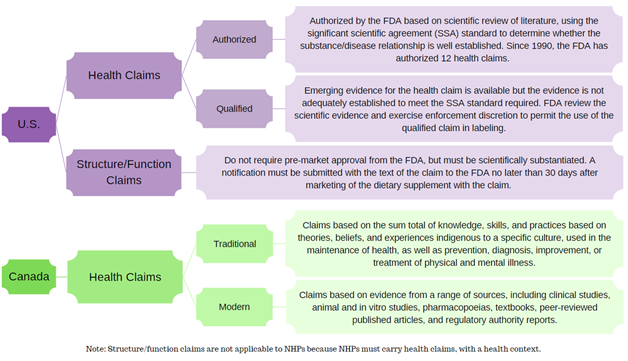
Constructed using guidance documents from the FDA and Health Canada.
Simply put, in order to avoid unnecessary and potentially costly consequences, we need to know the do’s and don’ts to consider when assessing a product’s claims potential.
.png?width=1080&name=Claims%20dos%20and%20donts%20(1).png)
SGS Nutrasource offers claims substantiation consulting to ensure regulatory compliance for your product label in line with the various geographical jurisdictions.
Speak to a member of our team on how we can support your regulatory needs.
RELATED CONTENT
-1.png?width=711&height=197&name=Related%20Content%20-%20for%20website%20pages%20(1)-1.png)
Tags: Claims, Regulatory, Dietary Supplements/Natural Health Products, market access
On July 6th, 2022, Health Canada published new labelling requirements under the Natural Health Products Regulations (NHPR). These changes are driven by a need to help consumers make informed choices and manage preventable harms through consistent, clear, and easy to understand product labels. The amendments also ensure alignment with rules that have already been established for comparable non-prescription drugs. Below is a summary of the key requirements.
Tags: Regulatory, Dietary Supplements/Natural Health Products
Summary: FDA announces draft guidance for industry on their policy to exercise enforcement discretion on delinquent notifications to encourage firms to submit NDIN to correct past failures. Read on to learn more.
Tags: Product Testing & Certifications, Regulatory, Concept to Claim, ingredients, market access
.png)
| Determining the appropriate regulatory pathway is not always straightforward, especially when introducing a product from Canada into the U.S., or vice versa. For example, some foods contain components that when isolated could be a dietary supplement/Natural Health Product (NHP), and under certain circumstances, even a drug ingredient. |
By the end of this blog post, you should have a good understanding of who regulates supplements in the US and Canada, and how they differ from food and drug regulations. Continue reading if you are looking for information on how to sell supplements in Canada or the US. Understanding the category definitions as laid out by the respective regulation is one way to discern between frameworks; see table below.
| Regulatory Category | Definition |
| Food Examples: Orange juice, poultry, bread, candy, live microbials |
Any article manufactured, sold or represented for use as a food or drink for human beings, chewing gum, and any ingredient that may be mixed with food for any purpose whatever. Source |
| Dietary Supplement (US) Examples: Vitamin D, echinacea, live microbials/probiotics, multi-vitamin gummy |
A product taken by mouth that contains a “dietary ingredient” intended to supplement the diet. Source |
| Natural Health Product (Canada) Examples: Multi-vitamin gummy, calcium, omega-3 oil |
A substance or combination of substances which is manufactured, sold or represented for use in:
|
| Drug Examples: Ibuprofen, vaccines, antibiotics |
A drug includes any substance or mixture of substances manufactured, sold or represented for use in:
|
Tags: Pharmaceuticals, Regulatory, Dietary Supplements/Natural Health Products

.png)